

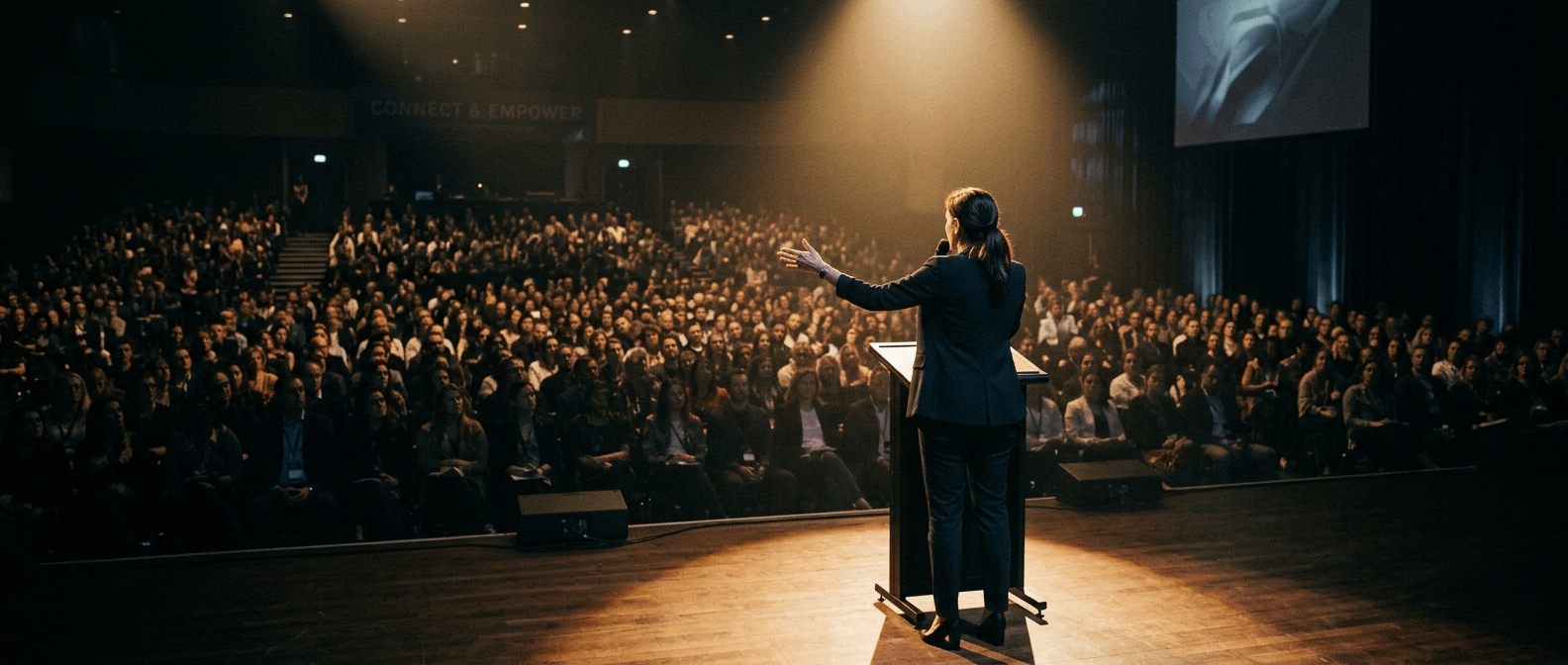
Most speaker training focuses on what you say and how you say it. The layer that actually determines whether a talk changes people is almost never discussed. It can be designed. Here is how.
There is a question I have spent most of my professional life trying to answer. I came to it through an unlikely route: film and television work in Hollywood, followed by decades of building mentalism shows and running my own residency at the Four Seasons in Washington D.C.
The question applies equally to every keynote speaker I have watched and to most of the talks I have sat through at conferences, leadership summits, and corporate events. Why do some presentations stay with people for years, while most are forgotten before the audience reaches the elevator?
The answer is not about delivery. It is not about content quality, slide design, storytelling technique, or stage presence. Those things matter, but they are not the solution. The answer is structural. Once you see it, you cannot unsee it.
The Problem with Being Impressive
Regardless of what they believe they are doing, most keynote speakers are actually demonstrating. They demonstrate expertise, research, and a framework for addressing real-world problems. They are skilled, prepared, and often compelling. The audience applauds. Then, somewhere between the conference room and the taxi home, the content starts to fade.
This happens because the presentation was a demonstration rather than an experience. There is a specific difference between a performance that shows something and one where something actually happens. A demonstration produces a reaction; an experience produces a change. Audiences remember experiences. They forget demonstrations, regardless of how impressive the delivery was, at roughly the same rate as the memory of them fades.
The gap between these two outcomes is structural. Most speaker training never addresses this because it focuses entirely on the visible layer of a presentation: what the speaker says and does. This leaves the "invisible layer" entirely to chance.
The Layer that Determines Everything
Every keynote operates on two levels simultaneously. The visible layer is the content delivered and the style of that delivery. This is where speaking coaches universally focus: slides, stories, stagecraft, and vocal variety. These are real skills, but they do not determine whether your audience leaves the room thinking differently than when they walked in.
The invisible layer is what the audience believes when they enter and what shifts within them as a result of the talk. This is where impact lives.
A talk that does not deliberately engage what the audience already believes, and then create a specific, designed disruption of that belief, is working with one hand tied behind its back. The content can be excellent and the delivery flawless, but if nothing the audience held as certain has been challenged, the experience produces applause instead of change.
Think about the last talk that stayed with you. It likely did not just provide new information. It made something you were already certain about feel suddenly, uncomfortably insufficient. It did not add to what you knew; it disrupted something you thought you knew. That disruption can be designed.
What Actually Creates Forward Pull
The instinct of almost every speaker is to open strong. They lead with a compelling statistic, a signature story, or a big laugh to establish themselves as someone worth listening to.
This is understandable, but it is a structural mistake. Opening with your most impressive material sets a ceiling rather than opening a question. The audience experiences something remarkable and then waits for the next remarkable thing. You have established a baseline of impressiveness that every subsequent moment must meet, yet you have done nothing to create the forward momentum that makes an audience need to hear what comes next.
The opening’s real job is to surface a belief the audience is already carrying, something they assume to be true but have never had reason to question. The goal is simply to bring it into the light.
When that belief is clearly present, everything that follows acquires different weight. The audience is no longer just collecting information. They are watching something they believe being tested. This creates the urgency that makes a talk feel necessary rather than merely interesting.
The specific belief you surface is the Inequity: the precise tension between what your audience currently holds as true and what the argument you are about to make demands they believe instead. Without an Inequity, a talk has a subject. With one, it has a reason to exist.
The Most Expensive Mistake Speakers Make
There is a nearly universal failure mode in keynote speaking that is rarely identified because it looks like good practice. It happens in the seconds immediately after a strong moment lands.
A story hits, a statistic reframes a concept, or a point lands with genuine weight. In that instant, before the audience has fully processed what they just received, the speaker moves on to the next slide or transition phrase.
What is being interrupted is the most valuable cognitive event in the presentation. When something disrupts an assumption, the audience’s mind begins a reconstruction. They rebuild what they just heard from the new position the disruption has created. This reconstruction is where the experience deepens from interesting to meaningful. It is where a moment becomes something the audience carries away.
It requires silence. Speakers, trained to fill every pause, almost never give it room. A few seconds of held silence after a strong moment is not dead air; it is the Shift in progress. The speaker who resists the pull to move on before the room has finished receiving what just landed is doing something that almost no speaker training teaches. Allowing the Shift is the deliberate decision to give the audience the space the disruption has earned.
The Redundancy Problem Nobody Names
Imagine a talk with five strong sections. Each is well-researched and well-delivered. The audience responds well to each, yet by the end, the cumulative impact feels less than the sum of its parts.
The problem is psychological redundancy: the repetition of the same kind of interior demand. If every section of a talk asks for five consecutive moments of intellectual surprise or emotional appeal, the audience’s capacity for that response diminishes. The first surprise is genuine; the fifth is expected.
A well-structured talk is not a series of independent moments. It is a single developing experience that changes character as it progresses, building toward a resolution that could not have arrived any earlier because it required everything that preceded it. That architecture requires thinking about your talk as a single story with a single central tension. Everything either serves that tension or it does not belong.
A Different Question to Start From
Most speakers ask: What do I want my audience to know? The question that produces a different kind of talk is: What does my audience believe right now, and what would it mean for that belief to fail?
This forces you to start from where the audience actually is. It requires you to identify the specific assumption your talk is about to disrupt and to design that disruption with precision. It also forces a more honest accounting of the talk's purpose. It is not to inform or inspire, but to change something the audience thought they knew.
For a quick diagnostic, describe your talk in one sentence without using the word "how." If your answer is "I'm going to show them how to lead through digital transformation," you have a topic. If your answer is "leaders believe they are modeling the behaviors required for change, but the people around them are experiencing something entirely different," you have an Inequity. The first tells you what you will deliver. The second tells you what you will disrupt.
Why This Matters
I developed this framework through magic, specifically through the years I spent building mentalism shows and Las Vegas productions. Magic is a clean laboratory for these questions because the results are visible in real time.
The principles governing whether a performance changes an audience or merely impresses them are identical across contexts. A talk with a deliberately surfaced belief, a designed disruption, and a closing that allows for change produces something beyond excellence. It produces the experience that keeps running in the audience’s mind long after they have left the room.
That experience can be built. The tools exist. They are just not where most speakers are looking.
Michael Jons is the author of Making Ideas Matter: A Speaker’s Framework for Talks That Change What People Believe and Making Magic Matter: A Framework for Meaningful Performance. Both are available at MakingMagicMatter.com.
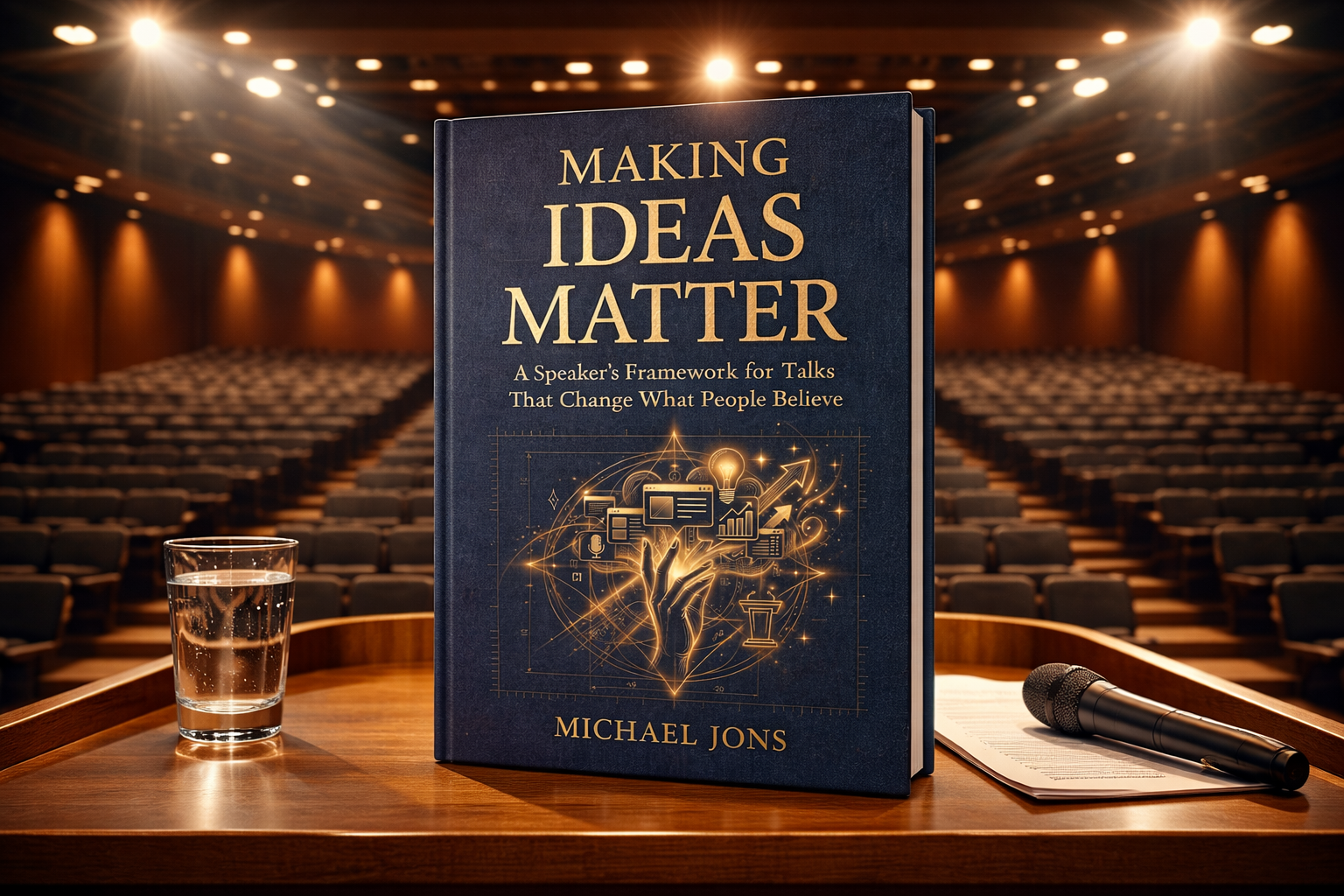
Making Ideas Matter
Your talk gets applause. But does it change what people believe?
Making Ideas Matter is a practical framework for keynote speakers who want more than a strong response — who want to design talks that produce genuine belief change. Developed from the Story Quad framework, originally built for magic performance and translated here for the speaking world. Fourteen worksheets. Four composite speakers. One diagnostic tool that will show you, in ten minutes, exactly where your current talk is falling short — and what the minimum effective repair is.
For thought leaders, author-speakers, and keynote professionals who have something real to say and want to know it landed.
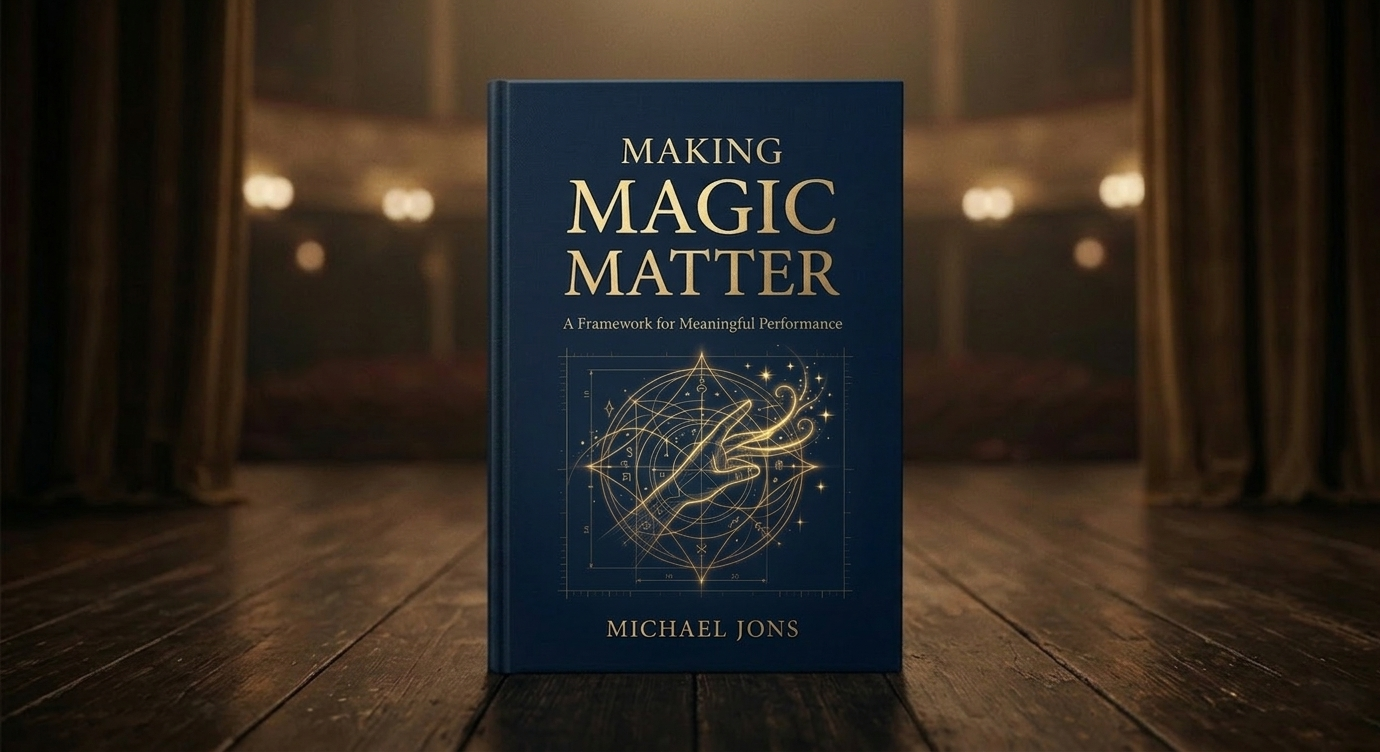
Making Magic Matter
You've put in the work. The moves are clean. The reactions are good. And yet something is off — a feeling that the performance is landing just short of where it should.
Most performers are told the answer is to tell a story. Add a premise. Make it personal. It helps a little. The gap remains.
Making Magic Matter identifies what that advice misses: the interior experience of your audience — what they believe before your effect begins, and what happens to that belief when the effect lands. That moment, the collapse of a felt certainty, is where magic actually lives.
This book shows you how to design for it, deliberately, every time.


Comments ()