


Mentalist Michael Jons, author of Making Magic Matter, on why the trick is almost irrelevant, and what actually determines whether a moment sticks with you over time.
I spent the early part of my career in Hollywood where I learned a lot about narrative, what makes a scene land and an ending feel earned. I have also spent several decades building mentalism shows, writing productions for other performers, running my own residency in Fort Lauderdale and at the Four Seasons in Washington D.C., and competing in The Magic Duel, the city's highest-rated comedy magic show.
Somewhere along the way, I became obsessed with a question neither world had answered: Why does some magic stay with you for years, while most of it disappears before you've reached the parking lot?
The answer I eventually found has almost nothing to do with the cleverness of the trick.
The Same Trick, Three Times
There's a lie-detection routine I've performed in very different contexts. Five volunteers answer questions. Only one of them is telling the truth, the rest are instructed to lie. I eliminate the liars round by round until only the truth teller remains.
It's a fun routine that I've used in three different shows. The sequence of events is the same in each show. The experience is not.
In my intimate mentalism show, The Psychic Cabaret, the routine is framed as a genuine demonstration of perceptual ability. The audience enters a space where something unusual might actually be happening. When I identify the liar, the room responds, but not with the immediate explosion of the comedy version. The reaction is warmer, more personal. Something has been confirmed about how readable people are, whether they know it or not.
In a comedy magic show, the same routine becomes a story about my childhood. I explain that I learned lie detection at age nine from a Catholic nun named Sister Mary Ignatius, a woman of strong convictions and immediate physical consequences. I produce a puppet: a nun in full habit with extendable arms and tiny boxing gloves. The final two answer silently. The puppet stares them down, then punches the liar in the face. The room erupts. The moment is loud, clean, and complete.
Then there's the version I wrote for Cashetta, the drag persona of Scott Weston. Cashetta claims she can sense fear, primarily through smell. She works through the rounds. With two remaining, she hesitates, takes their hands, raises their arms, and licks them both on the forearm. The audience howls. She then produces a giant bottle of hand sanitizer and sprays it generously. Here, you'll need this. I know where my mouth has been.
Same trick, three completely different experiences. The method is the one thing that didn't change.
So what did?
What Actually Determines the Experience
I've watched other performers do the same routine, using the same method, some nights it landed, many nights it didn't. What made the difference? If the basic routine is constant, what determines the experience?
The answer is this: magic works by collapsing a belief. It works when the audience holds a genuine certainty about how the world operates, and that certainty gives way.
In the mentalism show, the belief is personal: my thoughts are private. When that fails, the experience turns inward.
In the comedy version, the expectation is that this is a demonstration of skill. When a puppet delivers the verdict with a punch, that expectation collapses, and the result is laughter.
In Cashetta's show, the assumption is social: there are boundaries performers won't cross. The lick breaks that instantly. The hand sanitizer resolves it. The audience erupts because the moment lands exactly where it should.
The trick didn't change. The belief being disrupted did.
The Layer Most Performers Miss
Every performance operates on two visible levels: what the audience sees, and what happens. And two invisible ones: what the audience assumes to be true, and what happens to that assumption.
Most performers work almost entirely on the visible layer. They refine the method, sharpen the timing, clean up the handling.
But if the underlying assumption is vague, or never deliberately established, then nothing specific is at risk. When the moment arrives, there's nothing precise to disrupt.
The result is familiar: the audience registers that something impossible happened, but the experience doesn't land anywhere. It dissipates.
The trick worked. Nothing changed.
What Silence Is Actually For
There's a second failure point, and it comes right after a strong moment lands.
In that instant, the audience begins to rewind what they just experienced. Details reorder themselves. Moments that seemed incidental now feel meaningful. The experience deepens retroactively.
And then, in most performances, it gets interrupted.
The performer speaks. Moves on. Signals applause.
The reconstruction stops.
A few seconds of silence isn't empty space. It's the moment completing itself. Without it, even a strong effect lands thinner than it should.
A More Useful Question
This isn't just about magic.
Talks, films, writing, conversations, any experience operates against a backdrop of assumptions. When those assumptions remain untouched, the experience can be enjoyable, even impressive. But it doesn't persist.
When something disrupts them, even slightly, the experience continues after it ends. Your mind returns to it, not to solve it, but because it no longer fits cleanly. That's what gives a moment its half-life.
Most people try to create powerful moments by adding something: more spectacle, more cleverness, more intensity. But what lasts tends to come from removal. Remove an assumption the audience didn't realize they were relying on. Even briefly. That's enough.
The question I now ask about anything I create is not: Was it impressive?
It's: What did the audience believe, and what would it mean for that belief to fail?
Impressiveness fades. But when a belief gives way, the experience doesn't end when the moment does.
It keeps running.
Making Magic Matter is available at MakingMagicMatter.com
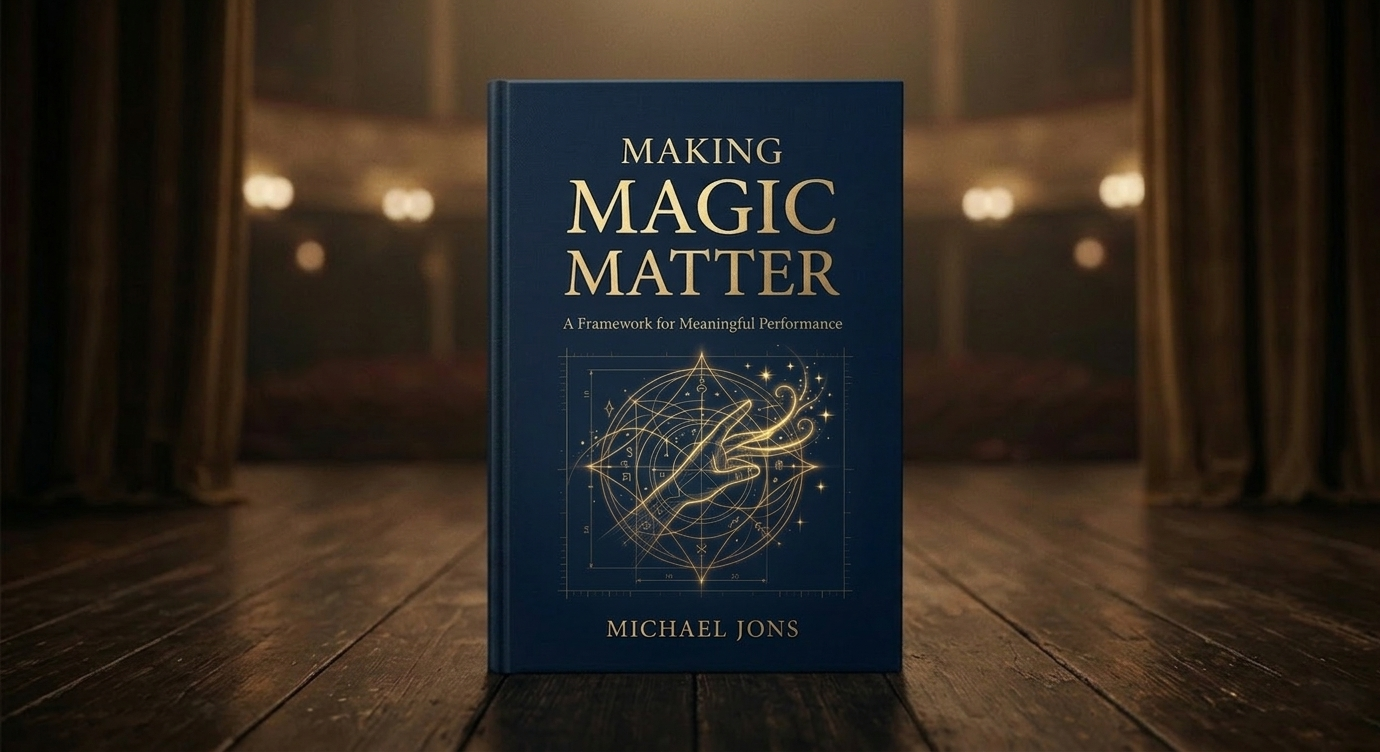
Making Magic Matter
You've put in the work. The moves are clean. The reactions are good. And yet something is off — a feeling that the performance is landing just short of where it should.
Most performers are told the answer is to tell a story. Add a premise. Make it personal. It helps a little. The gap remains.
Making Magic Matter identifies what that advice misses: the interior experience of your audience — what they believe before your effect begins, and what happens to that belief when the effect lands. That moment, the collapse of a felt certainty, is where magic actually lives.
This book shows you how to design for it, deliberately, every time.


Comments ()