

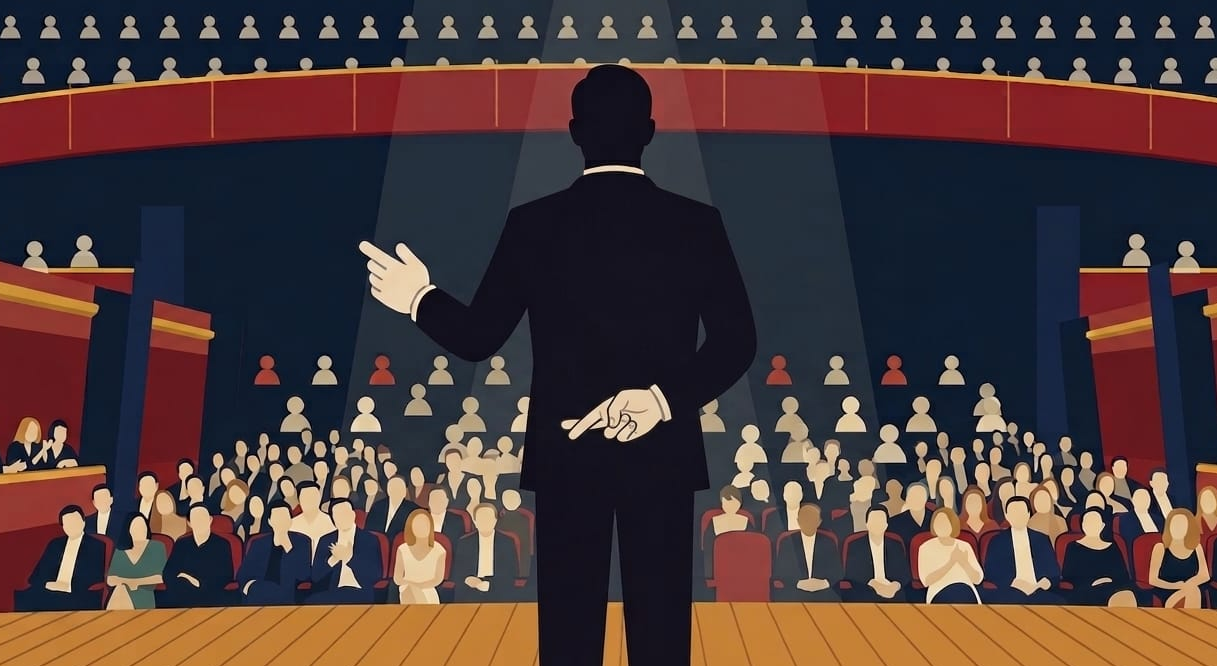
Every impossible thing a mentalist performs is standing in front of a real one. The job isn't to fake a power or apologize for it, it's to find the truth underneath and claim that. Musings from a working performer on sincerity, wonder, and the oldest honest job there is.
Almost every magician today claims to also be a mentalist. Unfortunately, most magicians who try mentalism find a way to ruin it. And they ruin it for the kindest possible reason: they don't want to lie to you.
It shows up two ways. The first is the wink. The performer divines the name of your first love and then tags it with a little disclaimer, of course I can't really do this, a wink to let everyone off the hook. The second is quieter and worse: no claim at all. The effect simply happens. The cards reveal themselves, the prediction comes true, and the performer stands beside the miracle like a technician who happens to be in the room. Nobody claimed a power, so nobody told a lie.
In both cases the magician has just taken the one art form built entirely on a claimed ability and quietly turned it back into a card trick. Mentalism, at its core, is the demonstration of an unusual ability. Remove the claim and you no longer have mentalism. You have a puzzle.
The guilt these performers feel is real, but the diagnosis is wrong. They believe the problem is that they would be falsely claiming a power they don't possess. The real problem is that no one ever showed them that the alternative to lying isn't disowning the power. It's grounding it.
Grounding doesn't mean confessing. It doesn't require gravitas, or a soul laid bare, or anything heavy at all. Max Maven grounded everything he did and never told you about his feelings; his grounding was a committed aesthetic, cold and exact and his alone. Some performers ground in sincere belief, some in a worldview, some in a character so consistent the audience stops asking where the man ends and the act begins. The claim of an unusual ability is mentalism's requirement, but how you fund it is up to you. I fund mine with things I actually believe, which is why that's the version I can show you from the inside. But it's just one way in, not a rule.
Let's be clear: mentalism is a theatrical dramatization of an unusual ability, usually of the mind, but not always. Our work can include physical acts like telekinesis, spoon bending, and contact mind reading as well. For the effect to succeed, the performer must faithfully embody the claimed ability, and that's where some performers, particularly magicians who have been trained on an ethical code to not lie, begin to get uncomfortable. The routine feels like an uncomfortable lie.
I never feel like a fraud because I try to make the routines I perform an expression of some underlying truth. Before I perform an impossible thing, I go looking for the true thing underneath it. There almost always is one. Once I've found it, I'm no longer pretending. I'm dramatizing and sharing something I actually believe in order to create a sense of astonishment, amusement or wonder.
Take prediction. I would never tell you I know your future. I don't. I don't believe anyone does. But if you're sitting in a car and start driving down a particular road, it takes very little to say where you'll be in thirty minutes. My theatrical prediction isn't clairvoyance, it's the dramatization of trajectory, of how much of what's coming is already visible in where you're aimed. I don't ever want people to feel like their future is predetermined. My framing preserves their sense of agency. I believe plainly, what Alan Kay said better than I can, that the best way to predict the future is to invent it. When I perform a prediction, that's the real and true thing I'm pointing at. The method is a secret. The idea is sincere.
The séance works the same way, though what's underneath it is stranger. I don't summon the dead. But I carry ghosts – the people I've lost, whose voices I still consult, whose particular way of being I still measure myself against. When a planchette moves under fingertips, it moves by the ideomotor effect, the small, unconscious muscle movements the sitters genuinely don't know they're making. That's not a metaphor I reached for to feel better about the routine. It's the actual mechanism, and it happens to be a beautiful one: the hand providing an answer to a question that the mind won't admit it's holding. So when I perform that routine, I'm dramatizing two things I believe without reservation. We carry the dead within us, and our own hands sometimes know things before we do.
This is the part nobody teaches, and I think it's the only part worth teaching.
There are libraries of methods. Every effect you could want is published, dissected, improved, and sold. What no one hands the guilty magician is the habit that comes before the method. The looking. The discipline of stopping in front of an effect, before you ever decide how to accomplish it, and asking: what is the real version of this? What is the true thing this impossible thing is standing in front of, the thing I could say to a friend with a straight face and truly mean?
It is a strange kind of homework, because it isn't about the trick at all. It's about you. The prediction led me to examine what I actually believe about how the future is built. The séance made me examine how I live with my own ghosts. I didn't choose those answers to justify the routines. The routines sent me looking, and those are what I found when I looked honestly. That's the whole move. You perform the effect, but you claim the truth, and because the truth is real, the claim isn't a lie, even when the method is a complete secret. The secret is how. The sincerity is what it's about.
And the truth that underpins our routines doesn't have to be solemn. Mine often are, because that's my temperament, but the thing you find can be wicked or funny or coldly clinical. A routine grounded in "I find people easy to read and it amuses me" is as honest as one grounded in grief. I've always wanted to perform a show that promises nothing but comically bad fortunes. The bar isn't profundity. It's that you've found something true for yourself that the audience can't quite dismiss. Sometimes that thing is heavy. Sometimes it's just true and light and a lot of fun.
Here is why I can't simply hand you my answers: they're useless to you. My ghosts aren't yours. What I believe about trajectory and the future isn't necessarily what you believe. If you took my grounding and performed it, you'd be standing next to a meaning that belongs to someone else. The looking doesn't transfer. The habit of looking does. The instruction isn't "believe what I believe." It's "refuse to perform a single thing you haven't first stood in front of and found something true beneath." Do that and the guilt has nowhere to live. You're not claiming a power you don't have. You're claiming something real and standing behind it.
Which brings me to the lie I tell anyway.
I'm not a purist. I don't know any mystery performers who are. Dunninger performed straight magic. Derren Brown does card tricks. My own show, Psychic Cabaret, climbs slowly into the realm of impossibility. It opens with routines that are easily accepted as real. Each subsequent routine raises the temperature of impossibility a degree, and somewhere in the second act I cross the line into demonstrating something that simply cannot be true. I do it on purpose. And here is the thing I want the purist in you to notice: it's the grounded work that came before that earns the crossing. If you open cold by demonstrating something impossible, it's seen as a trick, a puzzle, a how'd-he-do-that. Arrive there after forty minutes of wait, could that be real?, the same effect lands as wonder instead of as a riddle. The frame doesn't forbid the impossible. The frame is what gives the impossible its meaning. A discrete piece of magic, dropped inside a fully committed frame, borrows the frame's sincerity. The whole show is the costume, and a man in a Santa suit doesn't owe you a disclaimer.
It would be easy to say the trust I built gets spent on a lie at the end, that I spend an hour being grounded so I can sell one genuine miracle. But that isn't what the climax does. The audience doesn't walk out believing their future is absolutely knowable. They aren't fools, and I haven't claimed it. What they walk out with is smaller and harder to shake. They can't quite rule it out. The crossing doesn't ask them to believe the impossible. It asks them to sit for a while in not being able to dismiss it. That gap, the thing they can't close on the drive home, is the point. It isn't "how did he do that," which has an answer and dies the moment you hear it. This has no answer, and it follows them.
So the grounding was never a purity code I occasionally break. It's the engine. It's the thing that lets me break it and have the break mean something.
I'll resist the temptation to tell you this saves the world. It doesn't. But it does one small thing I've come to think is not small at all.
People go myopic. We learn the shape of what's known and quietly mistake its edge for the edge of what's possible. Most of adult life reinforces that mistake, the impossible gets filed under settled, and wonder gets treated as something you're supposed to grow out of.
I've always thought of myself as a tour guide to the edge of reality. I imagine reality like a cliff, but instead of eroding it gets slowly extended as people turn ideas into reality, an inch at a time. The performer doesn't pour that new ground. My job is only to guide people to the edge and ask, "what if?" Together we take a step to consider what just might be possible.
For a few seconds, a good routine holds a person there. It doesn't tell them the impossible is real. It lets them feel, briefly and honestly, the sensation of not being sure. That sensation is where every genuinely new thing starts, with somebody refusing to accept that the edge of the known is the edge of the possible. Designers and engineers have said as much for a century, that they built the thing because a story let them believe it was allowed to exist before the engineering caught up. The performance doesn't build the future. It keeps alive the one feeling the future depends on.
So to the magician with the guilt: that feeling isn't proof you're committing fraud. It's proof you understand the stakes, that you know the difference between a trick and a claim, and you don't want to lie. Good. Don't. But if you are going to perform mentalism, don't disown the power either, and don't drain the affect out until the miracle happens to no one. Find the true thing under the trick and perform that, all the way, without the apology. Then take the audience to the edge of what's real and ask them to look over. You're not deceiving them. You're showing them where the ground ends and asking them to wonder what's past it. That has never been a lie. It's the oldest honest job there is.
A Note on Disclaimers
Since this was posted, the discussion of this article has often centered on a question I didn't raise: whether a mentalist owes the audience a disclaimer. It wasn't my subject, but the interest is real and it follows closely enough from everything above that I'll answer it.
I'll start by granting the strongest version of the other side, because it deserves it. There is a genuine abuse here, and it isn't the supernatural claim everyone worries about. It's the performer who attributes trickery to a real, learnable skill, body language, micro-expressions, NLP, "I read people, and so can you", and then sells that skill as the actual method, in a book, a keynote, a brand. The problem isn't that he hid how the trick was done; every performer does that. The problem is that he made a falsifiable claim about human capability, presented it as true, and profited from the false expertise. That is dishonest in a way a dramatized séance is not, because the séance never pretended its mechanism was the real one. The critics who worry about this are right to. So is Hector Chadwick when he says mentalism may be the only performing art where the audience doesn't automatically understand the transaction, that the frame isn't self-evident the way it is when you saw a woman in half. I agree that can be true.
Where I part ways is the remedy. The instinct is to bolt a spoken disclaimer onto the front of the show. But the evidence suggests it barely works. In Gustav Kuhn's experiments, people told outright that the performer was a fraud went on believing he was psychic anyway; only learning how a trick was done moved them, and no performer is going to explain his methods from the stage. So the spoken disclaimer fails at the one job it's given: it doesn't change what the audience believes. What's left is honesty as a duty for its own sake, which I respect, but a duty discharged by a sentence nobody absorbs is theater of its own kind.
There's a fair reply to this, that you put up the traffic light even if some drivers run it; the failure of a few to heed an honest signal doesn't excuse you from giving it. I agree with the principle. But it argues for honesty, not specifically for a spoken disclaimer, and there are better ways to be honest than a denial the audience discounts as false modesty.
Because the thing that actually carries the honesty is the frame, and the frame is built, not spoken. I bill myself as a psychic entertainer. The whole transaction is a ticket to a show, and it ends at the theater door, I don't sell mind-control books, courses, or "real" credentials on the way out. Much of the evening runs on ordinary intuition: I read the room and the people in it the way anyone perceptive does, and I'm sometimes wrong, which the audience sees, and being wrong in front of them is often what makes the rest land. And when someone comes to me afterward genuinely needing to know whether what they saw was real, I tell them plainly, it's a show, a mix of real human observation and routines built so the evening succeeds every time. The honest answer is there for anyone who actually needs it, offered to the person standing at the edge without being forced on the person who'd rather keep the mystery. That, not a pre-show announcement, is the window left open.
So here is the whole of my position. For a disclaimer to be merited at all, two things have to be true at the same time. First, the frame has to be thin enough that a reasonable person could mistake the performance for a real-world claim. Second, there has to be a stake the audience could be harmed by acting on. Both are necessary; neither alone is enough. A private reading for a grieving widow, no stage, no curtain, a real decision on the line, can have both. A stage performer revealing the name of someone's first kiss has neither, and neither does the overwhelming majority of mentalism. A disclaimer exists to prevent real harm when someone misunderstands what is being claimed. Where there is no possible harm, there is nothing to disclaim, and you are left asking wonder to apologize for existing.
None of which excuses the false-credential performer, and notice that a disclaimer would not have fixed him anyway. The worst cases were never disclaimer problems at all. A British businessman named James McCormick sold more than seven thousand "bomb detectors" to Iraq and other governments and made around fifty million pounds; the devices were dowsing rods, repackaged from a novelty golf-ball finder, with no power source and no working parts. He was jailed for ten years, and the judge found that the false sense of security they created had contributed to death and injury at the checkpoints where they were waved over cars. Others selling the same kind of device were convicted alongside him. No pre-show disclaimer was ever going to touch that, because it was never a performance. It was fraud, the sale of a falsehood as a skill. The con was never in the discipline. It was in the man. Trickery is a tool; a healer and a predator can both pick it up, and which one is holding it is a fact about the person, not the craft. That is the point the essay above was making from the start. Ground what you do in something true, take responsibility for the frame, and never sell people a falsehood they'll pay for outside the theater. Do that, and the disclaimer was never the thing that mattered.


Comments ()