

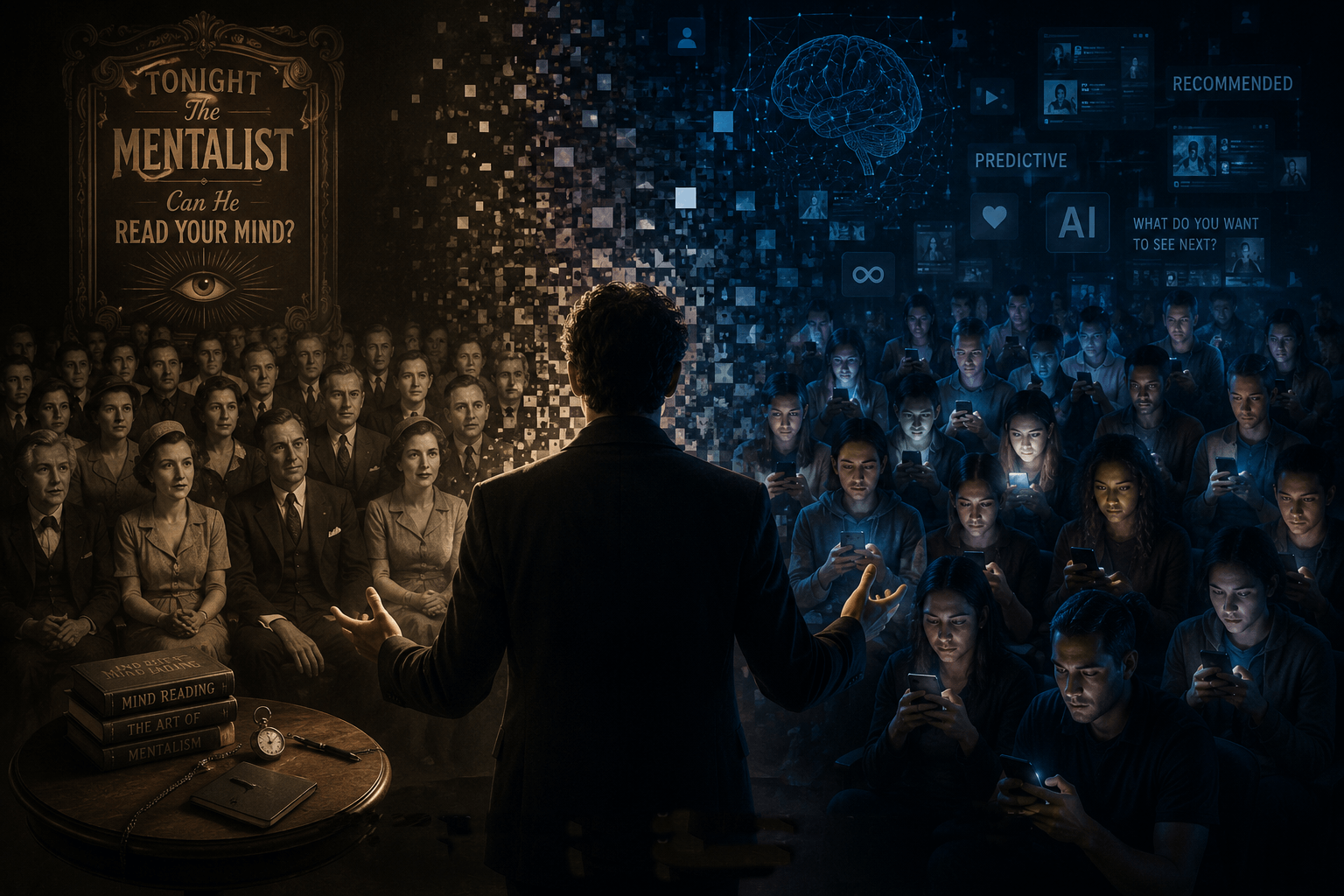
Are we performing mentalism for an audience that no longer exists? Exploring the mismatch between classical mentalism tropes and audiences reshaped by digital saturation, algorithms, and generative AI. How must mentalism evolve to reflect the realities of the people now sitting in front of us?
I've been "between shows" for almost a year now. After a decade performing my own residency shows, followed by a period competing in Washington DC's The Magic Duel, I've spent the last year living across several cities in Spain. That distance from the demands of regular performance has provided me space to think about what comes next. I'm still shaping what my next work will look like, but this break has allowed me to consider questions about the direction our art form will need to grow to remain vital and exciting in a changing audience landscape.
It occurs to me that many of us are performing shows we built in a different century. Not literally. We update bits, we refine our scripts, we replace magazine with phone routines. But the core of our work, the architecture of what we do, was first designed years ago for an audience whose interior life may no longer match the one of the audience sitting in front of us. The premises we rely on, the emotional contract we offer, the implicit promise of the ticket: all of it was calibrated to people who experienced the world differently from the people who are now buying seats.
This is not a crisis. Mentalism remains healthy. But the health is uneven, and some of what feels like a tough room or a flat reaction may actually be a mismatch between an aging emotional contract and an audience we have not fully accounted for. Current ticket buyers are often a generation or two removed from the assumptions that our work was built on. Our shows may still resonate for audiences of our own generation, but we are increasingly performing for audiences whose expectations and interpretive habits have been shaped by different cultural contexts than our own.
What follows are my personal thoughts, written in the context of developing my next show, on what seems to have shifted underneath us and what that might imply for the work ahead. My intention is not to resolve these questions here but to start a conversation within our community and invite others to share their thoughts, experiences and insights as we seek to better understand and appeal to our emerging audience's tastes, desires and expectations.
The Audience I'm Thinking About
The shifts I'm describing are most pronounced in particular audiences: urban and culturally literate American audiences. College-educated. Digitally saturated. The cultural mainstream of younger professional life. Performers working corporate gigs, cruise ships, casino rooms, tourist showrooms, and many international markets may find some of these dynamics muted or absent.
That said, the audience I'm describing has cultural influence beyond its size. They shape critical attention, online discussion, and the trajectory of what counts as fresh. Younger audiences in less coastal contexts often arrive at the same sensibilities over time. So this might be worth tracking even where it doesn't yet apply to your particular room.
One thing worth flagging about this audience specifically: they have a hair-trigger radar for inauthenticity. They've grown up watching curated personas across every platform, and they can smell a performance persona from across a room. To them, manufactured charm feels like a transactional sales pitch rather than a genuine connection. This is part of why unearned charisma fails so spectacularly with them.
What Still Gets a Gasp
I don't think wonder is dead. It isn't. A genuinely impossible event, well-staged, with human stakes attached, witnessed live, still gets gasps from younger audiences. Sometimes harder gasps than it used to because so much else feels fake.
What seems to have weakened over time is generic astonishment. Astonishment and trick-demonstration used to feel like the same thing. They don't anymore.
I think the reason is tied to exposure saturation. Younger audiences have grown up watching things that look impossible but turn out to be artificial – AI generated, a clever edit, or a paid creator with a production budget. The category of "I can't explain this" has been partially colonized by content that doesn't deserve their wonder, and they've adjusted accordingly. They haven't stopped being amazed. They've stopped investing emotionally in abstract impossibility. The astonishment has to be about something now. Attached to a person. Embedded in a moment that only exists because we are all in the room together.
The practical question this leaves us with: which moments in our shows cannot be reproduced on a screen? Those moments are increasingly the thing we're actually selling. The rest competes with content, and content is free.
Method Awareness is Higher than We Sometimes Assume
The algorithm has been teaching our audiences about our methods, whether they wanted it to or not. The same person who has never bought a magic book has, by their late twenties, scrolled past dozens of TikToks explaining force decks, billet peeks, equivoque, and dual-reality setups. They couldn't reconstruct it on demand, but the categories have been seeded.
Some classical effects that worked beautifully on uninformed audiences now require either better methodology, better framing, or different effects entirely. But this shift also creates an opening. We can now create work that doesn't depend on spectator ignorance, magic where the power is in the meaning of the moment, leaning into the fact that the audience already knows how the world works.
When a reveal is heavy enough with genuine human recognition, the mechanical explanation starts to feel tonally beside the point. The spectator who reaches for "that was probably a billet peek" in the middle of a moment that landed as pure, raw truth ends up looking small, not clever. The room's energy doesn't reward the explanation. This is one of the reasons the recognition-of-a-person framing matters so much in a method-aware environment. It isn't that we're hiding method better. It's that the texture of the moment makes the puzzle frame feel inadequate to what just happened. That's a more durable effect than fooling people, because it doesn't depend on the spectator not knowing how.
Mind Reading in the Age of the Algorithm
The audience member sitting across from you has, in the last twenty-four hours, been profiled with eerie precision by multiple apps on their phone. Their feeds know things about their sexuality, politics, and aspirations that they haven't told their closest friends.
Youtube knows that someone who watched these three videos is statistically likely to watch this fourth one. That's genuinely powerful, and it produces the felt experience of being read. But it isn't human recognition. The algorithm doesn't know you specifically, your current circumstances or what you find meaningful in your life at this moment.
I think this distinction is actually good news for mystery performers. We aren't in the pattern-recognition business; we're in the recognition-of-the-particular-human business. AI models predict. A good mentalist, at their best, sees someone. These are different operations, and audiences feel the difference even when they couldn't articulate it. We need to lean into that.
Generative AI sharpens the point further. An audience member can now ask ChatGPT for a tarot reading, a personality analysis, even a simulated conversation with a dead relative. Experiences that once felt uncanny or uniquely human are becoming technologically ordinary. That could lower the bar for “this thing understands me,” but I suspect the larger effect is the opposite. I encounter an increasing number of people who instinctively dismiss AI content, with reactions ranging from total boredom to outright dislike. The more that people experience machine-generated intimacy, the hungrier they become for genuine human recognition. The contrast is part of what gives live mentalism its power now.
So the reframe for mind reading is consistent with what many of you have been drifting toward already. Move the implicit frame away from data extraction, the naming of the card, the revealing of the word, and toward recognition of a person. Who they are and what they care about. Many of you have been shifting your performances in this direction on instinct. The cultural moment makes a case for doing it on purpose.
Of course, audiences are not consciously analyzing any of this. What's happening is more intuitive than analytical. People absorb cultural shifts like background radiation, and those shifts quietly dictate how a performance feels. Things register as either collaborative or manipulative, warm or smug, generous or sales-pitched. The audience isn't thinking through those distinctions deliberately, they simply feel them.
Influence in the Age of Constant Influence
This is the area where I think the shift is sharpest.
For a hundred years, "I can influence your choices" was thrilling because the audience experienced choice as fundamentally their own. To have it gently steered was startling, intimate, even flattering. It implied a hidden order beneath the surface of free will.
The contemporary audience no longer experiences choice this way. They experience choice as already manipulated. They know their feeds are engineered and their purchases are predicted. They know the wellness app, the dating app, the news app, and the political campaign are all running variations of the same persuasion machinery on them constantly. They aren't naive about influence. They're saturated by it, and often resentful of it.
What this means is that "I can influence your choices," sounds like the language of the people they've learned to distrust: the tech founder, political operative, or influencer with the affiliate code. The performer who leans hard on influence framing in 2026 is, without intending to, occupying the same rhetorical position as everyone the audience has been taught to be suspicious of.
This doesn't mean influence work is over. It means the framing has to change. A few directions I've been playing with:
Influence as exposure rather than demonstration. Instead of "watch me steer you," something closer to "watch me show you how steerable you already are." The performer becomes a witness to a phenomenon the audience is already living inside, rather than a wizard imposing it from outside. The audience leaves feeling informed about themselves rather than operated upon.
Influence as play rather than power. The dominance frame, the "I made you do this" posture, is aging badly. The collaborative frame, "let's see what happens if we try this together," still resonates. Same effect, different emotional contract.
Influence as contrast with the ambient condition. Maybe the most powerful move available to us right now is to fail to influence, deliberately, in moments where the audience expects success, and to redirect the demonstration toward something they can't be influenced about. The performer who can convincingly show the limits of suggestion is doing something the audience can't get anywhere else.
The underlying principle, I think, is that a younger audience's pleasure in being influenced is contaminated by their daily experience of being influenced for profit. Any framing that even faintly resembles that experience leaks the wrong associations. Framings that position us as an ally in the audience's relationship to their own mind tend to land cleaner.
Prediction in the Age of Pre-determined Outcomes
Prediction has its own problem, almost the opposite of the influence problem.
Classical fortune-telling depends on the future feeling open. The pleasure of being told about what's coming relies on the participant believing that what's coming is genuinely unknown. When the future feels open, predicting it is wondrous.
The contemporary audience doesn't experience the future as fully open, they experience it as substantially pre-determined. By algorithms, by economics, by climate trajectories, by political forces too large to influence, by data already collected about them that predicts what they'll do before they do it. Their relationship to the future is more anxious and more constrained than the audience of even fifteen years ago.
So "I can predict what you will do" lands on a different nervous system now. For an older audience, it's a delightful demonstration of order beneath apparent randomness. For a younger audience, it can confirm a fear they're already carrying. That they are, in fact, predictable. That their choices aren't their own and the future is closing rather than opening.
The reframe might be to emphasize the participant's role in producing the prediction, the contingent and surprising aspects of how it came about, the sense that the future being predicted is theirs rather than fate's. The fortune teller who tells the participant who they are becoming is doing different emotional work than the fortune teller who tells them what will happen to them. The first is generative. The second can feel like one more system closing in.
The "trust me, I'm clever" Position is Crumbling
There's a particular performance posture, common in our work, that I'll call the knowing position, where the performer occupies a slightly elevated stance. I see what you don't see. I know what you don't know. Audience pleasure comes partly from being outpaced by someone they trust.
This worked beautifully for a long time. I think it's working less well now. The knowing position is the exact rhetorical posture occupied by every bad actor the younger audience has been taught to distrust. "I understand you better than you understand yourself" is, in 2026, the language of manipulation. It's what predatory systems say.
This puts us in an awkward spot, because the knowing position is genuinely fun to play and audiences over fifty still mostly enjoy receiving it. The under-forty room may hear it differently, not as a promise but as a warning sign.
The adjustment, I think, isn't to become falsely humble or to dismantle our authority. Where authority was once used to flatter the performer, it can now flatter the audience when used in service of revealing them to themselves rather than demonstrating our superiority over them. Same skill set, different emotional contract.
Charisma and Command
Some performers are still winning over rooms through sheer charisma and those rooms include plenty of younger audiences. I don't want to suggest that mentalism's future is purely collaborative, emotionally intelligent, and socially aware, because that would under-read something real about what still works.
The distinction I'd draw is between unearned charisma and earned charisma. The unearned version is the assumed-superior posture without the goods. The performer who acts powerful because the role calls for it, who borrows the cadence of dominance without the substance underneath. That version is aging badly, and I think that's the part younger audiences are detecting.
Earned charisma is something else. The performer whose presence genuinely commands a room because of who they are and what they can do. Whose authority is unmistakable but not asserted. Whose mystery is theatrical force rather than pose. That hasn't aged at all, and I don't think it will. The audience that mistrusts the posture of dominance will still surrender happily to genuine magnetism, because they can tell the difference even when they can't articulate it.
So a lot of what I'm describing in this article is about the framing around the work, not the presence underneath it. If you are a performer whose strength is sheer command, this article isn't telling you to soften. It's asking what the command is in service of, and whether the contract you're offering the audience matches what they're now able to hear.
Sincerity Is Back
For about twenty years, irony was the safe register. You could perform anything if you signaled you knew it was a little ridiculous. That era is ending. Younger audiences are notably more willing to take things seriously, including ritual, ceremony, and sincere claims about meaning, than the audiences of the 2000s were.
There's a catch, though. They'll accept sincerity only when it doesn't feel like a sales pitch. The moment a sincere frame starts sounding like a TED talk or infomercial, it's over. Sincerity has to come without the apparatus of monetized authenticity around it.
For us, this is actually permission. We can stop apologizing for the strangeness of what we do. We can drop the wink. We don't need to constantly reassure the audience that we don't really believe any of this. What we can't do is replace the wink with a pitch for a workshop, a worldview, a book about manifesting, an upcoming course. The sincerity must be in service of the experience in the room, not in service of the performer's brand.
This might be the single biggest stylistic opportunity in front of us right now. The ability to be genuinely strange, genuinely earnest, and genuinely uncertain about what just happened, without leaning on either ironic distance or motivational framing.
The Role of Humor
Sincerity and irony aren't actually the only registers available, and the most effective performers I watch tend not to choose between them. They use humor as the binding agent between the two. Not ironic humor, which is sincerity's avoidance behavior, but with lightness that buffers intensity without undermining it.
This matters because audiences will accept far more strangeness, sincerity, authority, and emotional weight from a performer who's also clearly funny than from one who isn't. Humor signals that the performer has perspective on what they're doing. It signals trustworthiness. It signals that the performer isn't asking the audience to take them more seriously than they take themselves. Enormously valuable in a moment when audiences are hypervigilant about being managed.
The trap is the wrong kind of humor. Defensive humor, which apologizes for the strangeness of the work, doesn't build trust, it signals that even the performer doesn't believe in it. Audiences feel the difference between "I know this is weird and I'm above it" (defensive) and "I know this is weird and I'm into it" (calibrated). The first is the old ironic register. The second works.
A lot of the performers I admire most across magic and mentalism land here. They're sincere about the work, weird without apology, and deeply funny. Who doesn't love Rob Zabrecky? The humor isn't the entertainment; it's the medium that makes the actual entertainment metabolizable. Pure earnestness without this calibration often loses the room in ways that are hard to diagnose afterward.
What We Might Have Going For Us
The temptation, having named all of this, is to conclude the work has gotten harder. In some ways it has. But I think there's a more interesting truth underneath, which is that the cultural moment has handed us a set of strengths we didn't fully have before. Some of what felt like our limitations a decade ago has quietly become our advantage.
Recording diminishes us less than it diminishes most live forms. Almost every live form has been hollowed out by the recording. Stand-up specials, concert films, sports replays. Once the recording becomes the dominant way to consume the content, the live event becomes a paler shadow. Mentalism isn't immune to this. Derren Brown built a real career partly through television. Netflix specials have launched performers. But comparatively, we survive recording badly. The thing that happens between performer and participant, and between the participant and the rest of the room, doesn't transfer well to camera. The recorded version is reliably worse than being there, often dramatically so. This used to feel like a frustration. It's now an advantage. Audiences increasingly know the difference between things worth showing up for and things they can catch later. We're firmly in the first category.
We offer a particular form of stranger-to-stranger contact. Plenty of live forms put strangers together, but we offer a specific version that's rare even among live forms. In most live entertainment, the audience watches the performers. In mentalism, the audience watches each other. The volunteer is witnessed by the room. The room reacts together to something that happened to one of its own. This triangulation, performer to participant to audience, with the audience implicated in what they're watching, is unusually rare. Combined with the broader loneliness conditions of contemporary life, that specific sense of intimacy has acquired a value worth recognizing.
The social architecture around us has collapsed, and the show can do some of the work that used to happen elsewhere. The sociologist Ray Oldenburg coined "third places" for the informal social environments that sit between home and work. Cafes, bars, barber shops, community centers, churches, social clubs. The defining features were that they were low-cost, drop-in, conversational, and that the social interaction was the activity. A ticketed residency show, however beloved, isn't a third place by that definition.
What is true is that third places have been collapsing for decades, and the collapse accelerated dramatically after 2020. Younger adults have grown up with fewer of them than any previous generation. They feel the lack.
A residency show in a fixed venue has the potential to expand to do some of the social work that third places used to do. The regulars who come back. The bar before the show. The lobby conversations after. The audience isn't just buying a show. They're buying membership in a small, weird, recurring community organized around a strange premise. I think this is enormously valuable and almost completely unrecognized as a category of offering.
Many younger people have never entered the institutions that used to provide shared heightened experiences: church, lodge, certain civic gatherings. The appetite those institutions met hasn't gone away, it just doesn't have many places to land anymore. A mentalism show, or the venue that hosts one, can offer something of what those gatherings offered. A bounded period of shared attention. A sense that something is happening that matters. Strangers responding to the same thing at the same time in the same room.
We work in a register that earnest media can't. We sit in a peculiar tonal position. We can be sincere without being self-help, ritualistic without being religious, strange without being whimsical, intimate without being therapeutic. Very few contemporary forms can occupy that space. Wellness culture is too monetized. Religious institutions have lost authority for much of this audience. Therapy has its own register. Theater is often too earnest, comedy too defensive. We can talk about meaning, fate, intuition, identity, and connection without the apparatus that makes those topics feel uncool or pre-packaged. It's ours largely by default, and we should use it.
Our subject matter has gotten more interesting, not less. Consider what we're actually about, beneath the methods. The nature of attention; the porousness of choice; the strangeness of intuition. The way coincidence feels different from chance. The experience of being known. Every one of these has become more culturally charged in the last decade. The audience is more interested in how attention works because theirs is constantly being extracted. More interested in choice because they suspect theirs is being manipulated. More interested in being known because they fear being surveilled. More interested in intuition because they feel they've lost touch with theirs. The material we've been working with all along has become more resonant because the cultural moment made it urgent. We didn't have to update the subjects. The world updated around them.
Live and unscripted-feeling is now luxurious. Ten years ago, the live performance market was crowded and the digital alternative was thin. That has inverted. The digital alternative is now infinite and free, and anything genuinely live has acquired a scarcity premium. Audiences who wouldn't pay forty dollars for a movie ticket will pay eighty for an experience that feels like it could only have happened that night.
The form rewards craft the algorithm can't. Content optimized for algorithmic distribution rewards a narrow set of qualities: quick hooks, high contrast, easy comprehension, emotional spikes. A skilled mentalist in a room rewards qualities the algorithm actively penalizes: patience, ambiguity, calibrated escalation, comfort with silence. Younger audiences who have grown up inside algorithmic distribution often describe a well-paced live performance as restorative. The experience of having their attention treated as something worth earning rather than something to be hijacked. We're one of the few cultural forms that practices the opposite of what the feed teaches.
A Note on Spectacle
Nothing above should be read as an argument for minimalism. Our future probably isn't stripped-down chairs-in-a-circle psychological theater, even though that aesthetic has its appeal. It's more likely hybridization. Intimate psychological work combined with theatrical sophistication. Sincere material staged with visual richness. Community dynamics inside venues that take design and atmosphere seriously. Younger audiences aren't anti-spectacle. They're anti-empty-spectacle. The same craft question applies as always: does the staging serve the moment, or is it seeking to do the work the moment should be doing?
Where It All Lands
Put the strengths together and a picture emerges that I find genuinely encouraging.
The mentalist of the next decade is positioned to be something more than a performer of effects. They're positioned to be the host of a recurring, irreproducible gathering where strangers experience something together they can't get elsewhere. A small, weird, sincere community organized around questions about the mind that the rest of the culture can't ask without sounding either clinical or commercial.
I don't think the younger audience is lost to us. They might actually be more aligned with what mentalism is capable of than the audience our shows were originally built for. They're lonelier, more curious about the mind, more skeptical of mediated experience, more hungry for real contact, more aware of what algorithmic life has cost them. They'll pay for the right thing. We're unusually well-positioned to offer it.
Questions Worth Sitting With
None of this requires rebuilding what you've spent decades developing. It's more about asking some specific questions about the show you already have. I've been asking myself most of these while thinking about my next show, and I offer them in that spirit, not as a test but as prompts.
- Which moments in your show would survive being recorded and posted, and which only work live? Both have value but they do different jobs. The unrecordable moments are increasingly your actual product. The recordable ones, often audience-work segments, are your promotional material. A well-built show uses both deliberately.
- Where does your influence work risk sounding like advertising or manipulation, and could it be reframed as exposure, play, or collaboration without losing the effect?
- Where does your prediction work risk confirming an audience member's existing anxiety about being predictable, and could it be reframed to feel generative rather than fatalistic?
- How does your show account for the fact that your audience has seen exposure clips? Do your effects play strong even when the spectator has a rough idea of the method?
- What separates your show from what a sophisticated AI can now seem to offer (categorization that feels like knowing) and what surveillance systems already do (data extraction that feels like reading)? Could your reveals smack of research? Where in your show is the moment of recognition that no machine can manufacture?
- How does humor function in your show?
- If you trade on charisma and command, is it earned or asserted? What do you use your authority in service of?
- When the audience leaves, what do they talk about? "How did he do that" means you've made content. "Did you see what happened to that woman in row four" means you've made an event.
- If you ran this show in the same venue every month for two years, would audiences want to return? Would the regulars start to know each other? Would the room start to have its own culture? If not, what would have to change?
Rising to the Moment
The audience under forty has a different interior life than the audience our shows were built for. They aren't less intelligent. They aren't less capable of wonder. They're differently inoculated, differently anxious, differently saturated. Their hunger for things screens can't give them is real. Contact. Recognition. Genuine unpredictability. The experience of being in a room where something happens that depends on them being there.
These are things mentalism, at its best, has always been able to deliver. The question is whether the framing of our work, the contract we offer at the door, is still pointing the audience toward what we're actually capable of giving them, or whether it's pointing them toward an experience we designed for someone who's no longer in the room.
We're in a rare moment when the form is open. I don't think that's something to fear. I think it's an invitation to reconsider what this art form is actually for, what audiences are truly seeking from it now, and what makes mentalism feel alive and necessary in this particular moment. I'd genuinely like to hear what the rest of you are noticing.
Comments ()