


I find the proliferation of AI content both fascinating and exhausting. But the flood of soul-less, synthetic content may be doing us a favor; it's teaching us the value of live, human interaction once again. We're finding our way back to the campfire - and the magic and laughter that lives there.
I have started to notice that images, genuinely beautiful and technically accomplished images that would once have stopped me mid-scroll, were leaving me cold the moment I suspected they were AI-generated. Not mildly indifferent. Actively unmoved and faintly annoyed. The content looked high quality, perhaps even better than what most people could create, but the feeling it produced in me was the opposite of what it should have been.
I've spent my working life at an unusual intersection. I've been a published photographer, a practicing magician, a writer, and a computer engineer. Each of those disciplines provided me a different way to express myself in the world. What I was looking for in those photos, and not finding, was evidence of a human soul at work.
A photograph has always been more than an image. It's proof that someone stood in a specific place, in a specific light, and decided that this particular moment was worth capturing. The technical end result was never as important as the act of capturing a moment of personal inspiration. A drawing is perhaps an even more intimate expression, the residue of a person’s struggle with their own hand and intention. Even a badly written sentence carries the trace of a mind genuinely trying to express something. When we look at any artistic endeavor, we naturally see through the work to the human impulse that created it. That's where its value lies. We never had to think about it before, because it was always there.
AI removes that signal. The image exists, but nobody actually created it. There is no human soul behind the imagery. For me, something that should produce a sense of wonder instead produces a sense of being deceived, not by the content, but by the frame. The frame says "creative work," and when I greet it with my attention, there is no human spirit there to meet me.
Of course, when AI is used as a tool in service of a human vision, it carries a trace of the person directing it. The choices, the prompting, and the judgment are all human acts. What produces the hollow feeling is something else: generation that substitutes for the human encounter rather than serving it.
This is also why AI is incapable of being funny. A joke can not be created through pure structure, it requires human sensibility. A person needs to notice some incongruity in the world and find just the right way to share so it creates a laugh. You can teach a computer to recognize the architecture of a joke, but you cannot teach it to find the world genuinely absurd. That requires actually living in it. As AI becomes more prevalent, I am becoming ever more sensitive to the difference. A joke without human inspiration behind it is hollow in the same way a smile without warmth behind it is hollow. We detect the absence of an interior state and it makes the experience feel dead.
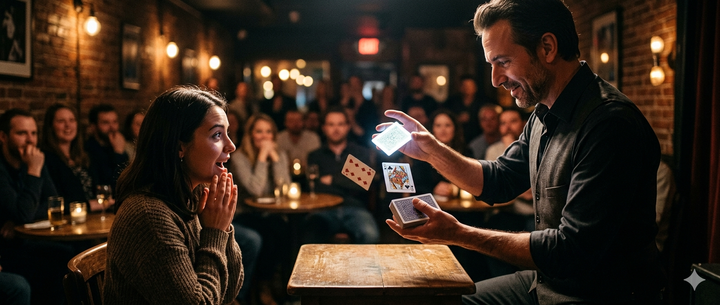
I'm beginning to appreciate what stand-up comedy and live magic give us. In a world of digital replacements, we are becoming more sensitive to the experiences that can never be digitized. We need the visceral experience of a performer producing the impossible just a few feet from our face, the group connection that happens when strangers laugh together in a room.
These art forms produce something we are lacking: real human interaction and connection. They produce moments where we can gather, laugh together, be amazed together, and actually connect in real human ways.
AI has inadvertently made our need for connection visible by removing it. We are developing a new literacy around the art of the human interaction, learning to feel its absence in work that previously would have seemed complete. It is making us more attuned to the difference between content that carries a human interior and content that only presents the appearance of one.
We are returning to the campfire, the place where stories are told and received in real-time. We are rediscovering the value of experiences that are alive in a way no recording can fully replicate. A recording might preserve the content, but it can never capture the current that runs between the people in the room.
As so much of the real world seems to melt away, replaced by digital substitutes, the campfire remains something a machine can never replace. The campfire, and the human encounter that it created, was always the point; we just had to travel far enough away from it to finally see that.

Comments ()